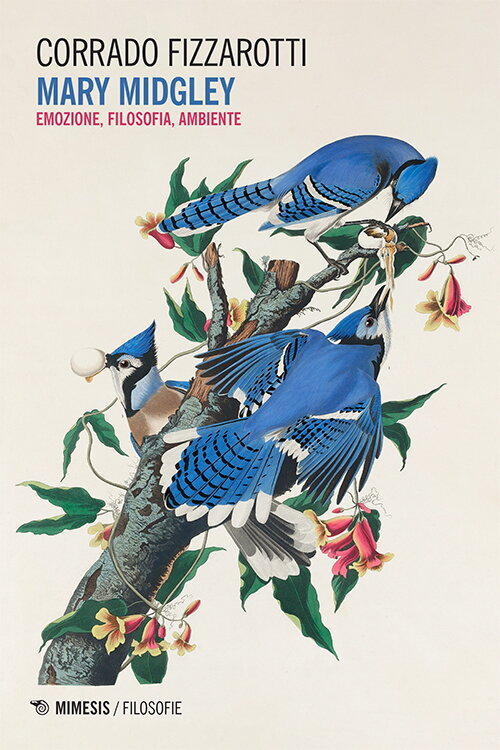
Cover of Mary Midgley: emozione, filosofia, ambiente

Books / 04

Mary Midgley: emozione, filosofia, ambiente

An introduction to Mary Midgley’s life and thought, bringing emotion, scientific understanding and responsibility towards living beings into conversation. Philosophy examines the concepts that shape experience and guide our choices.

Credits
Fizzarotti, C.
Contribution
Author
Year
2020
Publisher / publication
Milano: Mimesis
Publication status
Published
Original language
Italian
ISBN
978-8857571546
  • Mary Midgley
  • ethics
  • emotions
  • philosophy of science
  • ethology
  • human nature
  • environmental ethics

The book

Our images of human beings have consequences. They shape what we recognise as motivation, the place we give to emotion, and the relationships we imagine with other animals. Mary Midgley: emozione, filosofia, ambiente introduces a philosopher whose work follows these connections across ethics, science and ethology. The book brings her intellectual life into conversation with the problems that continue to make her work valuable to read.

Its starting point is an understanding of philosophy rooted in experience. Concepts organise our lives even when they remain implicit; examining them can reveal contradictions and assumptions that an isolated perspective might leave untouched. Midgley’s criticism of reductionism addresses the ambition to exhaust a complex reality through a single explanatory language. Scientific knowledge enters this inquiry alongside reflection on the questions we ask of it and the images that shape its interpretation.

This opens onto the question of human nature. Continuity with other animals, the diversity of motivations, and the interdependence of reason and emotion call for an intricate account of moral subjects. Understanding behaviour and justifying choices remain distinct tasks, yet our descriptions of the beings involved affect the scope of our attention. The movement from epistemology towards ethics and the environment therefore provides a thread through the discussion: questions about knowledge lead towards the issue of how to inhabit a world shared with other living beings.

Published in Italian in 2020, this volume offers an introduction to that constellation of questions. It addresses readers discovering Midgley and those looking for philosophy that can connect areas often studied separately. Fizzarotti’s later APhEx profile, published in 2022, and Continuità, published in 2025, extend the engagement with her thought. Together they allow readers to pursue two connected directions: the historical and philosophical reconstruction of her work, and the development of questions in animal and environmental ethics.
Ways into the book

Concepts in everyday life

Midgley’s understanding of philosophy guides the reading: identify the images and assumptions that make experience intelligible, then re-examine them where difficulties arise. The starting point is the relationship between thought and lived experience.

Science, emotion and human nature

Engagement with science and ethology helps illuminate the complexity of human motivations. Emotion and continuity with other animals become central philosophical questions about what we seek in an account of ourselves.

From ethics to coexistence

The relationship between understanding and moral attention opens the discussion towards other living beings and the environment. The later APhEx profile offers a separate introduction in greater depth; Continuità continues the dialogue within environmental ethics.

Recognising an image of the world

One useful reading question concerns the images that support an argument: what account of human beings makes a particular explanation of behaviour plausible? What place does it give to dependence, emotion and other animals? Following these questions connects the book’s epistemological and ethical discussions and helps identify the philosophical work performed on descriptions of everyday life.

Two further steps

The 2022 APhEx profile revisits Midgley’s historical and theoretical context in a separate text available through the University of Trieste’s public repository. To follow the consequences of this engagement for environmental ethics, continue to the JoLMA article and Continuità. These are later stages in the author’s work, each with its own questions and format.

Reviews and readings

References and links

Continue along a path